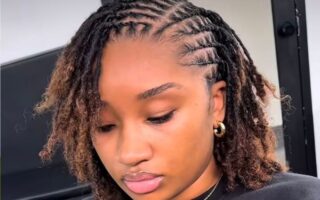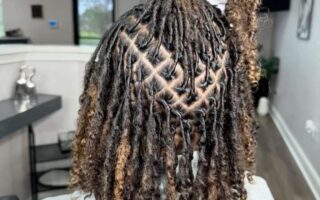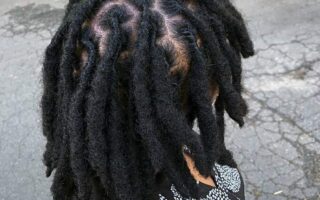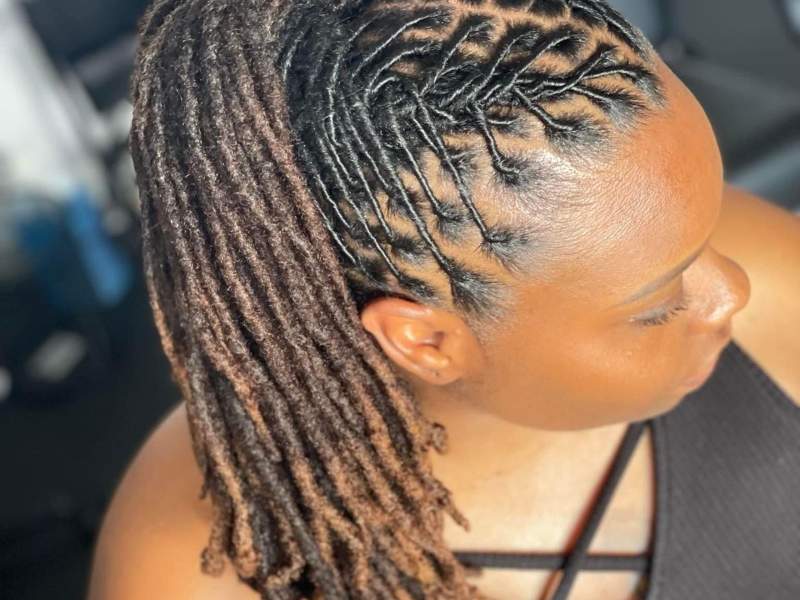
Ponytail loc style are among the easiest and most attractive ways to style locs.Whether you are going to work, meeting friends, attending a wedding, or enjoying a relaxed weekend, a ponytail loc style can help you look stylish without spending hours in front of the mirror.
For people with locs, ponytail loc style offer plenty of possibilities. You can wear your locs high on your head, gather them loosely at the back, sweep them to one side, or create an elegant bun. Each style offers something different, allowing you to express your personality while keeping your hair manageable.
However, there is something more important than achieving a beautiful hairstyle: protecting your hairline.
Tight ponytails can place excessive tension on your roots, particularly around your forehead and temples. Over time, repeated pulling may cause breakage or contribute to traction alopecia, a form of hair loss associated with prolonged tension on the hair.
The good news is that you do not have to give up ponytails to maintain healthy locs. Choosing comfortable Ponytail Loc Styles, using suitable accessories, and allowing your scalp to rest can help you enjoy different looks without unnecessary pulling.
This guide explores beautiful ponytail ideas, practical styling techniques, and simple maintenance habits to help you keep your locs looking their best.
Why Protecting Your Hairline Matters
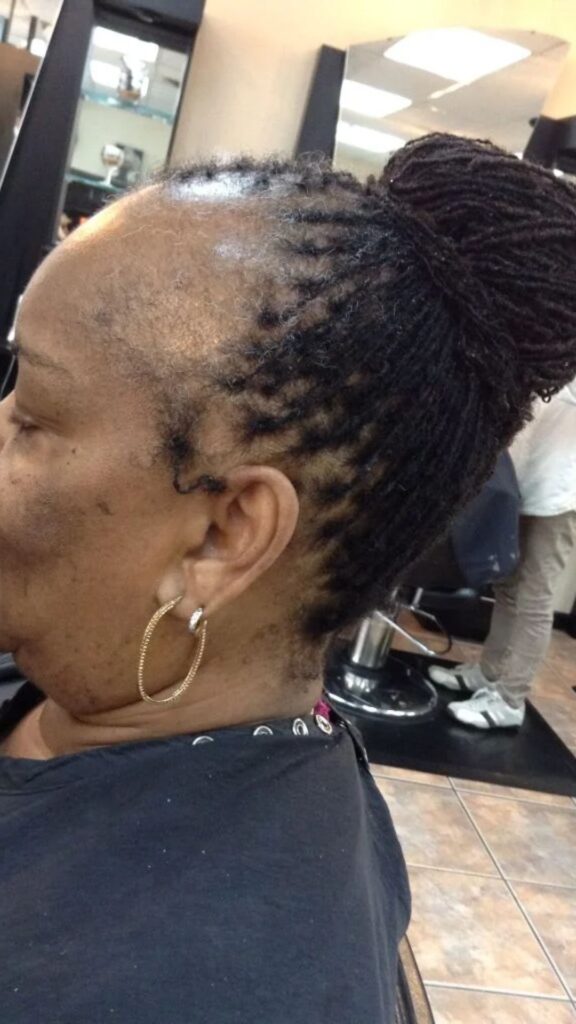
Your hairline frames your face and contributes to the overall appearance of your hairstyle. The locs around your forehead and temples may be particularly noticeable when you gather your hair into a ponytail.
Unfortunately, these areas can experience significant tension when you repeatedly pull your locs backward.
You might initially enjoy a tightly secured ponytail because it looks neat and stays in place. However, if your scalp feels sore afterward, your hairstyle may be placing too much pressure on your roots.
Watch for warning signs such as tenderness, small bumps, broken hairs, or thinning around your temples.
Healthy Ponytail Loc Styles should feel comfortable. You should not have to tolerate headaches or persistent tightness to achieve an attractive appearance.
The weight of your locs also matters. Long, thick locs can place additional strain on the roots when gathered together, especially when secured high on the head.
Consider your loc length, thickness, and scalp sensitivity before choosing a hairstyle.
If you notice persistent thinning or irritation, avoid tight hairstyles and consult a dermatologist. Early attention can help prevent further damage.
Looking for stylish ways to keep your locs healthy and protected? Explore these protective styles you can do with locs to protect your hair while reducing unnecessary manipulation and maintaining a neat, beautiful look. From elegant updos and low-tension buns to stylish half-up hairstyles, these protective loc styles offer practical options for everyday wear, special occasions, and healthy loc maintenance.
The Locs Loose High Ponytail
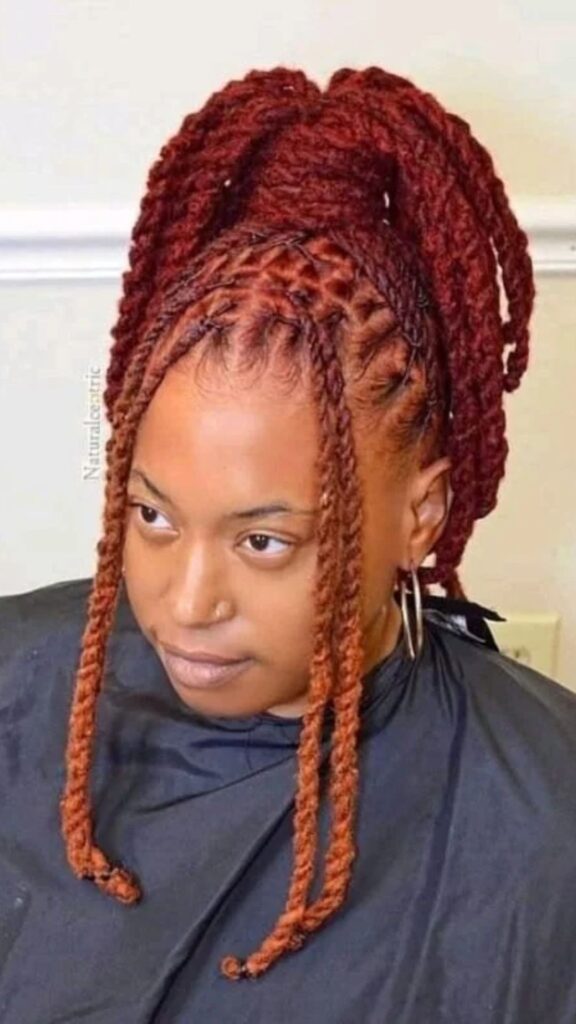
A high ponytail creates a lively, confident appearance. It draws attention to your face and allows your locs to become the main feature of your hairstyle.
This option works beautifully for casual outings, parties, and everyday activities.
To create the style, gently gather your locs toward the crown of your head. Use your hands to arrange them rather than pulling forcefully at the roots.
Secure the ponytail with a soft accessory that accommodates the thickness of your locs.
The most comfortable Ponytail Loc Styles do not require excessive tightness. If your locs feel heavy when gathered high, move the ponytail slightly lower.
You can also leave a few locs around your face for a relaxed appearance.
Avoid repeatedly tightening the ponytail throughout the day. If it begins to feel uncomfortable, loosen it rather than forcing your scalp to tolerate the tension.
A high ponytail can look beautiful without your hairline being pulled completely flat. Allowing your locs to sit naturally creates an attractive finish while prioritising comfort.
The Relaxed Low Ponytail
A low ponytail is a practical choice for anyone who prefers understated elegance.
Gather your locs near the nape of your neck and secure them gently. The resulting hairstyle looks neat without requiring you to lift all your hair toward the crown.
Low Ponytail Loc Styles work well for office settings, family gatherings, dinner dates, and everyday errands.
They are also useful when you want to change your appearance without manipulating your locs excessively.
For a polished finish, wrap one loc loosely around the hair tie if its length allows. This simple detail hides the accessory and creates a coordinated appearance.
You can also introduce a side part or leave a few locs loose around your face.
Remember that low ponytails can still cause tension if you pull your hair tightly backward. The lower position does not automatically make a hairstyle safe.
Gather your locs gently and check that your scalp feels comfortable before securing them.
If you have long locs, allow their length to fall naturally rather than pulling everything into a small, restrictive bundle.
Among the most versatile Ponytail Loc Styles, the relaxed low ponytail is an excellent choice for people who want simplicity and elegance.
The Half-Up, Half-Down Ponytail
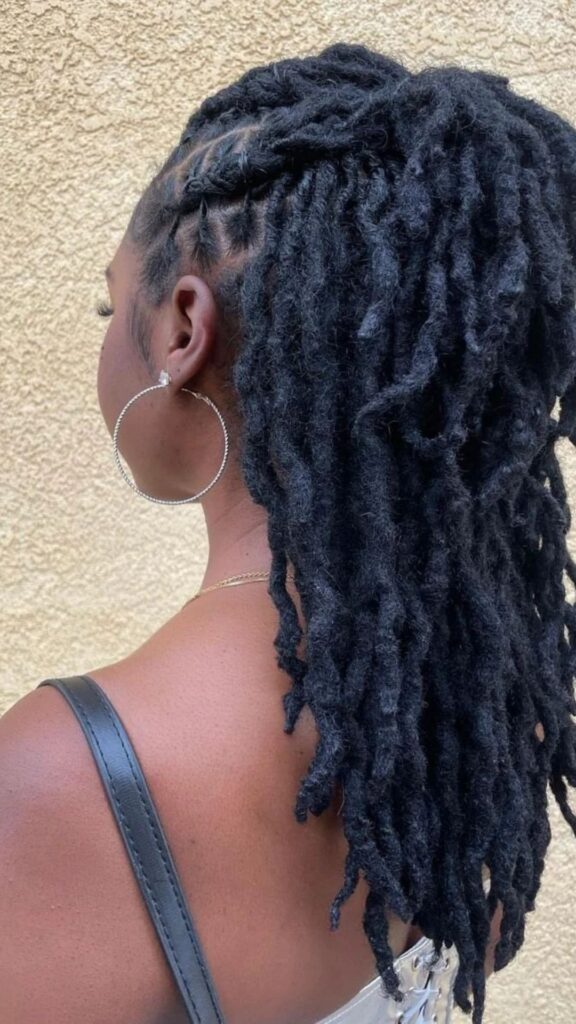
Sometimes, you want your locs away from your face without gathering all your hair into one ponytail.
The half-up, half-down style offers exactly that balance. It keeps the upper section of your locs secured while allowing the remaining length to fall naturally around your shoulders.
Start by separating a comfortable section from the front and crown of your head. Gather that section loosely and secure it with a suitable hair tie.
Leave the rest of your locs down.
These Ponytail Loc Styles are ideal for casual outings, celebrations, and days when you want a relaxed but intentional appearance.
You can position the gathered section near the crown or slightly farther back, depending on your preference.
Be mindful of the amount of hair you collect. Gathering too many heavy locs into a small section can create unnecessary tension.
If the style feels uncomfortable, reduce the size of the ponytail or reposition it.
You can also leave a few locs around your face to soften the look.
This hairstyle is particularly useful when you want variety without complicated braiding or extensive manipulation.
The Side Ponytail
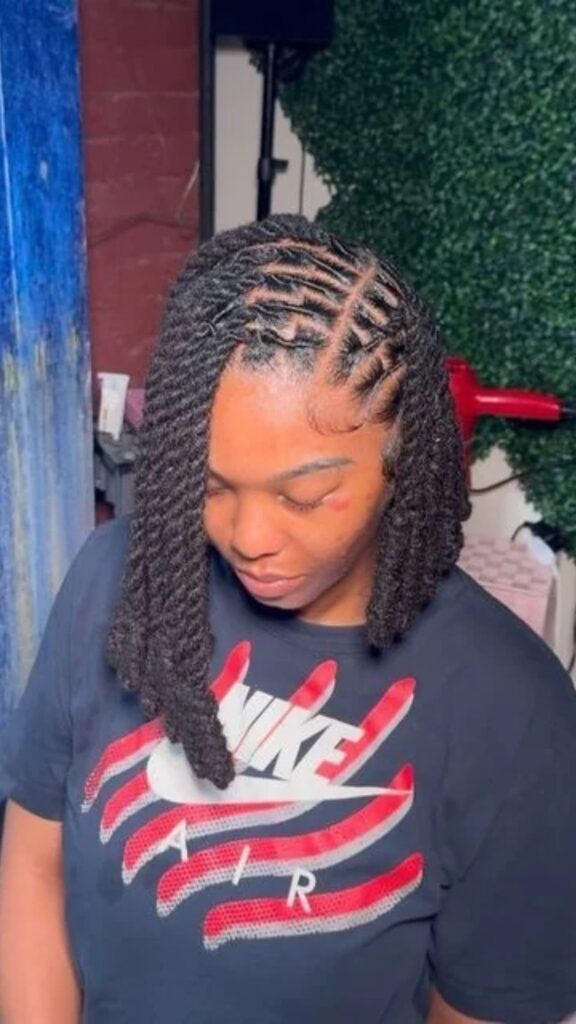
A side ponytail adds personality to your appearance while keeping your styling routine simple.
Instead of gathering your locs directly behind your head, guide them gently toward one side. Allow the length to fall over your shoulder if that feels comfortable.
Side Ponytail Loc Styles can look playful, elegant, or romantic, depending on how you arrange your locs.
They pair well with dresses, casual outfits, and traditional clothing.
For a little extra detail, add a lightweight hair cuff to one or two locs. Choose accessories that will not snag your hair or irritate your scalp.
Avoid pulling your locs too far across your head just to create a dramatic side-swept appearance.
If the style causes discomfort around your temples, loosen it or choose another placement.
You can also alternate sides occasionally rather than repeatedly placing tension on the same area.
A side ponytail demonstrates that you do not need complicated styling techniques to achieve an attractive result.
With gentle handling, this hairstyle can become one of your favourite everyday options.
The Low Ponytail With Face-Framing Locs
Leaving a few locs around your face can transform a simple ponytail into a softer, more expressive hairstyle.
Begin by choosing a few locs near your forehead or temples to leave loose. Gather the remaining locs into a low ponytail and secure them comfortably.
The result is relaxed and elegant without looking overly structured.
These Ponytail Loc Styles work well for professional settings, casual outings, and special occasions.
You can allow the loose locs to fall naturally or arrange them gently around your cheeks.
Avoid repeatedly manipulating the front locs to achieve a perfectly symmetrical appearance. Natural movement often makes the style more attractive.
Be cautious when applying styling products around your hairline. Excessive product application may contribute to buildup or irritate sensitive skin.
If you prefer a polished appearance, use products sparingly and follow a suitable cleansing routine.
This hairstyle is also adaptable to different loc lengths. Shorter locs can frame the forehead, while longer ones may fall alongside your cheeks.
The result is a beautiful style that does not require pulling every loc tightly backward.
-
The Loose Crown Ponytail
A crown ponytail gathers your locs toward the upper part of your head, creating a lifted appearance.
It can look striking with long locs, especially when the length falls naturally behind you.
However, this hairstyle requires attention to weight and tension.
Gather your locs gradually and stop at a height that feels comfortable. Do not pull your roots upward simply to achieve a dramatic shape.
If your locs are particularly long or heavy, consider gathering only part of them into the ponytail.
This adjustment reduces the amount of weight supported by the gathered section while preserving the overall appearance.
Crown-inspired Ponytail Loc Styles can be suitable for celebrations, photographs, and everyday activities when arranged gently.
Avoid wearing a tight crown ponytail repeatedly if you notice discomfort around your temples or forehead.
You can also experiment with a slightly lower placement to create a softer silhouette.
Remember that a hairstyle should remain comfortable throughout the time you wear it.
The Wrapped Ponytail
A wrapped ponytail is a simple way to create a more polished appearance without adding many accessories.
First, gather your locs into a comfortable ponytail. Then take one suitable loc and wrap it loosely around the hair tie.
Secure the end carefully if necessary, making sure the accessory does not pull on your roots.
Wrapped Ponytail Loc Styles are suitable for professional settings, dinners, weddings, and other special occasions.
The wrapped detail gives your hairstyle a coordinated finish while keeping the focus on your locs.
Avoid forcing a short loc to wrap tightly around the base. Choose a loc with enough length to sit comfortably.
Be careful when using pins or clips, as sharp accessories can catch on locs or press against your scalp.
When removing the style, unwrap the loc slowly instead of pulling it free.
This small habit helps reduce unnecessary friction and makes your styling routine gentler.
The Ponytail Bun Locs Style
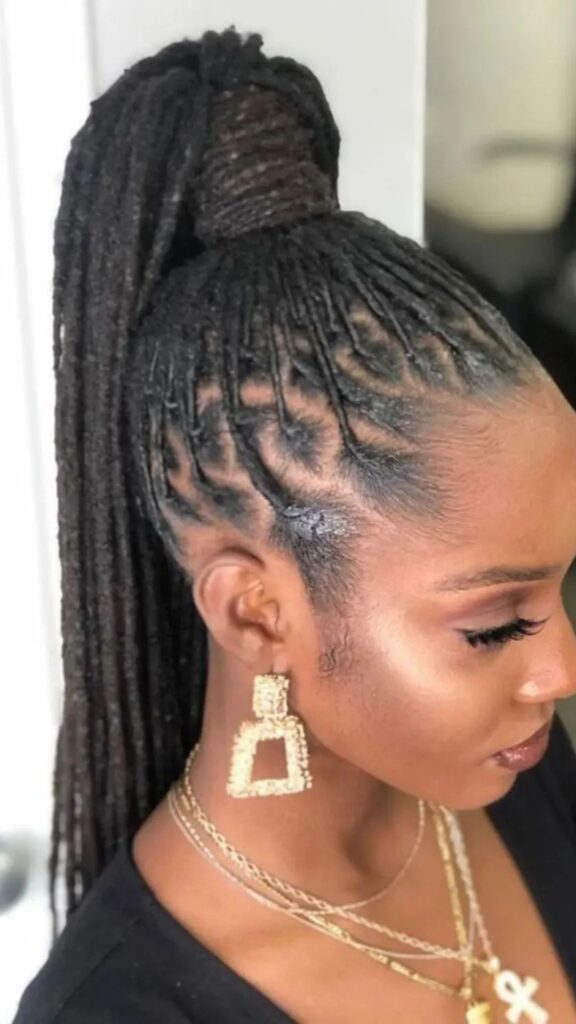
A ponytail bun is useful when you want your locs away from your face and neck.
Gather your locs into a comfortable ponytail, then arrange the length into a loose bun. Use an appropriate accessory to hold everything in place.
Avoid twisting your locs forcefully or wrapping them so tightly that the base becomes uncomfortable.
For long or heavy locs, a loose bun may be more manageable than a tightly wound one.
These Ponytail Loc Styles are practical during warm weather, busy workdays, and household activities.
They can also create an elegant appearance for formal occasions.
However, a bun should not feel heavy or pull persistently on your scalp. If you notice discomfort, release it and try a different arrangement.
Avoid sleeping with a tightly secured bun. Loosening your locs before bed allows your scalp to rest.
A comfortable ponytail bun can provide convenience without requiring complicated styling.
The Ponytail With a Side Part
Changing your part is one of the simplest ways to refresh a familiar hairstyle.
A side part creates an asymmetrical appearance that can complement your features while keeping your styling routine manageable.
Use your fingers to create a comfortable part. Avoid scratching your scalp or repeatedly forcing your locs into a position that does not feel natural.
Gently gather your locs at the back of your head and secure them into a low ponytail.
These Ponytail Loc Styles are suitable for professional environments, social events, and everyday wear.
If your locs are thick, choose an accessory wide enough to accommodate their volume.
You can also leave a few locs loose near the front for a softer finish.
The goal is to create a hairstyle that looks attractive without requiring excessive manipulation.
Choosing the Right Hair Accessories
The accessories you use can influence how comfortable your ponytail feels.
A hair tie designed for fine hair may not accommodate thick locs. It might squeeze the hair, become difficult to remove, or create unnecessary pressure at the base.
Soft fabric-covered ties are often useful because they can reduce direct friction compared with thin elastic bands.
However, material alone does not guarantee comfort. The accessory must also fit your locs properly.
When creating Ponytail Loc Styles, choose hair accessories that hold your hair without forcing it into a restrictive shape.
Avoid tight rubber bands, sharp clips, and decorative pieces that catch on your locs.
If you use hair cuffs, choose lightweight options and position them carefully.
After removing an accessory, check whether any locs have become tangled around it.
If removal requires force, consider choosing a different accessory.
Preparing Your Locs Before Styling
A little preparation can make styling easier and help reduce unnecessary manipulation.
Start by checking your scalp. If it feels sore or irritated, consider wearing your locs loose rather than gathering them into a ponytail.
If your locs need washing, follow a routine suited to your hair and scalp. Allow them to dry thoroughly before securing them for an extended period.
Avoid applying excessive oil, gel, or styling cream. More product does not necessarily mean healthier locs, and heavy buildup can make cleansing difficult.
Before creating Ponytail Loc Styles, gently separate any locs that have become caught together.
Never pull them apart forcefully.
Gather your hair slowly and pay attention to how the roots feel. If the style becomes uncomfortable during preparation, stop and adjust it.
These simple habits help make styling a comfortable part of your routine.
How Often Should You Wear Ponytails?
There is no single schedule that works for everyone.
The frequency with which you can comfortably wear ponytails depends on your loc length, thickness, scalp sensitivity, and the amount of tension involved.
Long, heavy locs may place more pressure on the roots than shorter locs.
If you wear ponytails frequently, alternate between different positions and occasionally leave your locs loose.
Try a relaxed low ponytail one day, a half-up style another day, and a natural look when you want to give your scalp a break.
The best Ponytail Loc Styles are those that suit your lifestyle without causing discomfort.
If your scalp becomes tender, loosen the hairstyle and avoid repeating the same tension-producing arrangement.
Remember that a ponytail that feels comfortable for a short outing may become uncomfortable after several hours.
Pay attention to your scalp and adjust your routine accordingly.
Protecting Your Locs at Night
Nighttime care is an important part of maintaining healthy locs.
Before bed, loosen tight ponytails and allow your scalp to relax.
If you prefer to keep your locs together overnight, choose a loose arrangement that does not pull on the roots.
A satin or silk bonnet, scarf, or pillowcase may help reduce friction between your locs and bedding.
Choose a covering that fits comfortably without squeezing your forehead.
For people who regularly wear Ponytail Loc Styles, separating daytime styling from nighttime care can be helpful.
If your hairline feels sore after wearing a ponytail, avoid recreating the same style the following morning.
Persistent tenderness, bumps, or thinning should not be ignored.
Common Ponytail Mistakes to Avoid
One common mistake is pulling the roots tightly to achieve a sleek appearance.
A smooth ponytail can look attractive without excessive tension. Your natural hairline does not need to be completely flat.
Another mistake is using accessories that are too small. If you struggle to fit your locs into a hair tie, choose a larger accessory instead of squeezing your hair.
Wearing the same tight ponytail every day can also repeatedly stress the same areas.
When choosing Ponytail Loc Styles, avoid excessive brushing, forceful parting, and repeated pulling on delicate locs around your temples.
Be cautious with heavy extensions or decorative additions that increase the weight your roots must support.
Most importantly, never ignore pain.
If your ponytail causes headaches, discomfort, or visible pulling, loosen or remove it immediately.
- Styling Different Loc Lengths
Your loc length can influence which ponytail styles feel comfortable and look balanced.
If you have short locs, a half-up ponytail may be easier to create than a full ponytail. Gather a small section and allow the remaining locs to frame your face.
For medium-length locs, a low ponytail or side ponytail can provide an attractive balance between convenience and flexibility.
Long locs offer additional possibilities, including wrapped ponytails and loose ponytail buns.
However, longer locs can also be heavier, so avoid arrangements that place excessive tension on the roots.
Choose accessories that accommodate your loc thickness and allow your hair to sit naturally.
The most suitable Ponytail Loc Styles are those that complement your current loc length without creating discomfort.
Keeping Your Locs Fresh Without Overstyling
It can be tempting to change your hairstyle every day, especially when you discover several attractive ponytail options.
Experimenting is enjoyable, but constant manipulation can become tiring for your scalp and locs.
Choose a few comfortable Ponytail Loc Styles that suit your daily activities and rotate between them.
For example, wear a low ponytail for work, a half-up style for a casual outing, and your locs loose when you want something simple.
Keep your accessories organised so that styling takes less time.
Avoid automatically adding more gel or oil whenever your hairstyle needs refreshing.
Sometimes, changing the ponytail position or gently arranging a few locs is enough.
Your locs do not have to look identical every day. Their natural texture and movement are part of their beauty.
When to Give Your Scalp a Break
Sometimes, the best styling decision is to leave your locs down.
If your scalp feels tender, your temples appear irritated, or your hairline seems thinner than usual, take a break from ponytails.
Repeated tension can contribute to traction alopecia, and early attention may help prevent further damage.
Look for warning signs such as persistent soreness, bumps, redness, broken hairs, or thinning around your forehead.
These symptoms can have different causes, so consult a dermatologist if they continue.
In the meantime, avoid tight ponytails, heavy hairstyles, and other practices that pull on the affected areas.
You can still enjoy your locs without tying them up.
Remember that Ponytail Loc Styles are options, not obligations. Your scalp deserves comfort just as much as your locs deserve thoughtful care.
Building a Simple Loc Care Routine
You do not need an expensive collection of products to care for your locs.
Start with a few consistent habits: keep your scalp clean, allow your locs to dry thoroughly, and use products suitable for your needs.
Choose accessories that fit comfortably and avoid excessive tension when styling.
When creating Ponytail Loc Styles, gather your hair gently and check how your scalp feels before securing it.
Give your scalp breaks from repeated styling, and pay attention to changes in your hairline.
If you notice unusual breakage or thinning, adjust your routine and seek professional advice when necessary.
Your routine should be realistic enough to maintain. Two or three favourite hairstyles may be all you need for most occasions.
Over time, you will learn which styles complement your locs and suit your lifestyle.
Frequently Asked Questions
Can ponytails damage locs?
Ponytails do not automatically damage locs. However, tight hairstyles and repeated tension can cause breakage and contribute to traction alopecia.
Choose comfortable styles and avoid pulling excessively on your hairline.
What is the best ponytail for protecting my hairline?
A relaxed low ponytail can be a useful starting point because it does not require lifting your locs high on your head.
However, comfort depends on your loc length, weight, and styling technique.
Can I wear a high ponytail with long locs?
Yes, provided it feels comfortable. If your locs are heavy, consider a lower ponytail or a half-up style that reduces the weight gathered into one section.
Are ponytails suitable for starter locs?
Some gentle styles may be suitable, but developing locs require careful handling. Follow your loctician’s advice and avoid excessive manipulation.
How do I know when a ponytail is too tight?
Pain, headaches, persistent tightness, bumps, and visible pulling are warning signs. Loosen or remove the hairstyle immediately.
Can I use gel for a sleek ponytail?
You may use a suitable product if it agrees with your scalp and locs. Avoid excessive application and repeated manipulation around your hairline.
Should I sleep with my ponytail in?
It is generally sensible to loosen tight hairstyles before sleeping. If you secure your locs overnight, choose a comfortable arrangement that does not pull on the roots.
In summary
Enjoy Beautiful Locs Without Sacrificing Their Health,Ponytails offer countless ways to express your style while keeping your locs manageable.
From loose high ponytails and elegant low ponytails to side-swept looks, wrapped styles, and ponytail buns, there are many options to explore.
However, protecting your hairline should always be part of your styling routine.
Choose comfortable accessories, avoid excessive tension, and give your scalp regular breaks. Pay attention to changes in your hairline and seek professional advice if you experience persistent thinning or irritation.
Remember that beautiful locs do not need to be tightly pulled back to look attractive.
With gentle handling and consistent care, Ponytail Loc Styles can help you enjoy versatile hairstyles while prioritising the long-term health of your locs.
Your locs deserve to look good, but they also deserve to feel good. When you make comfort part of your styling routine, you give yourself the freedom to enjoy both.